Suffering from Hip Pain?
Hip pain often starts with people finding it difficult to sit or squat. They experience an immense amount of pain when doing so. The region or the muscles of hip can hurt a lot, whenever they are pressure on the affected area.
Hip pain can hurt people a lot when they try to sit or sleep. Most of the people affected with hip pain often have a tough time sleeping at night.
Getting a surgery done or going for the hip replacement is not the only way one can relieve one’s hip pain. There are some alternative methods or treatments which can help a person to deal with his/her hip pain in a better way.
Hip pain can hurt people a lot when they try to sit or sleep. Most of the people affected with hip pain often have a tough time sleeping at night.
Getting a surgery done or going for the hip replacement is not the only way one can relieve one’s hip pain. There are some alternative methods or treatments which can help a person to deal with his/her hip pain in a better way.
Hip Labral Injury
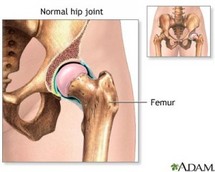
What is Hip Labral Injuries? Hip Labrum injury is the onset of pain located at the front of the hip joint. With all hip problems, the pain may become diffuse and hard to pinpoint. Swelling is not obvious, although the inflamed joint may become larger in volume because of an effusion due to trauma.
If the front of the hip joint is affected there may be a pinching sensation when the person flexes the hip by bringing the knee up to the chest. The pain may be reproduced in sport during activities that require weight bearing and twisting – i.e. kicking a football.
What are the causes?
Orthopaedic Surgeon like Doctor Kevin Yip, uses Arthroscopic for the hip, which is a procedure that can be performed on an outpatient basis which take less than an hour. A tear in the Labrum can be seen and trimmed using the arthroscope
If the front of the hip joint is affected there may be a pinching sensation when the person flexes the hip by bringing the knee up to the chest. The pain may be reproduced in sport during activities that require weight bearing and twisting – i.e. kicking a football.
What are the causes?
- Degenerative Tear
- Traumatic Hip Labral Tear
Orthopaedic Surgeon like Doctor Kevin Yip, uses Arthroscopic for the hip, which is a procedure that can be performed on an outpatient basis which take less than an hour. A tear in the Labrum can be seen and trimmed using the arthroscope
Piriformis Syndrome
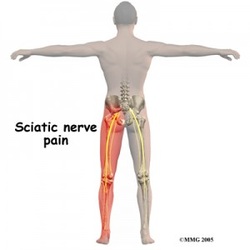
What is Piriformis Syndrome? This inflammation is typically caused by the plica being caught on the femur, or pinched between the femur and the patella. The most common location of plica tissue is along the medial (inside) side of the knee. The plica can tether the patella to the femur, be located between the femur and patella, or be located along the femoral condyle. If the plicae tethers the patella to the femoral condyle, the symptoms may cause it to be mistaken for Patello-femoral Syndrome. Because of this similarity in symptoms, Plica Syndrome is frequently misdiagnosed as Patello-femoral Syndrome. Diagnosis is often complicated by the thin structures of plicae, fenestrated septum or unfenestrated septum all being too fine to resolve well even in MRI.
The plica themselves are remnants of the fetal stage of development where the knee is divided into three compartments. The plica normally diminish in size during the second trimester of fetal development, as the three compartments develop into the synovial capsule. In adults, they normally exist as sleeves of tissue called synovial folds. The plica are usually harmless and unobtrusive; Plica Syndrome only occurs when the synovial capsule becomes irritated, which thickens the plica themselves (making them prone to irritation/inflammation, or being caught on the femur).
What are the treatments? Treatment for Plica Syndrome should focus on decreasing the inflammation of the synovial capsule. First, the care provider may prescribe a non-steroidal anti-inflammatory medication. Therapeutic exercise and modalities may also be used to treat the plica. Iontophoresis and phonophoresis have been utilized successfully against inflammation of the plica and the synovial capsule. Rehabilitative exercises should begin when inflammation and pain have decreased. Surgical removal of the plica of the affected knee may be necessary.
The plica themselves are remnants of the fetal stage of development where the knee is divided into three compartments. The plica normally diminish in size during the second trimester of fetal development, as the three compartments develop into the synovial capsule. In adults, they normally exist as sleeves of tissue called synovial folds. The plica are usually harmless and unobtrusive; Plica Syndrome only occurs when the synovial capsule becomes irritated, which thickens the plica themselves (making them prone to irritation/inflammation, or being caught on the femur).
What are the treatments? Treatment for Plica Syndrome should focus on decreasing the inflammation of the synovial capsule. First, the care provider may prescribe a non-steroidal anti-inflammatory medication. Therapeutic exercise and modalities may also be used to treat the plica. Iontophoresis and phonophoresis have been utilized successfully against inflammation of the plica and the synovial capsule. Rehabilitative exercises should begin when inflammation and pain have decreased. Surgical removal of the plica of the affected knee may be necessary.
Hip Bursitis
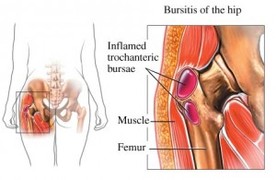
What is Hip Bursitis? Bursitis is caused by inflammation of a bursa, a small jelly-like sac that usually contains a small amount of fluid. Bursae are located throughout the body, most importantly around the shoulder, elbow, hip, knee, and heel. They act as cushions between bones and the overlying soft tissues, and help reduce friction between the gliding muscles and the bone.
The bony point of the hip is called the greater trochanter. It is an attachment point for muscles that move the hip joint. The trochanter has a fairly large bursa overlying it that occasionally becomes irritated, resulting in hip bursitis (trochanteric bursitis).
What are the causes?
The bony point of the hip is called the greater trochanter. It is an attachment point for muscles that move the hip joint. The trochanter has a fairly large bursa overlying it that occasionally becomes irritated, resulting in hip bursitis (trochanteric bursitis).
What are the causes?
- Fall or trauma to be hip
- Post-surgical
Hip Pointer
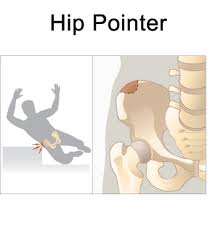
What is Hip Pointer? A hip pointer injury is an extremely painful, acute injury to the iliac crest of the pelvis. The injury causes bleeding into the abdominal muscles, which attach to the iliac crest. The bone and overlying muscle are often bruised, and the pain can be intense. Pain may be felt when walking, laughing, coughing, or even breathing deeply.
Hip pointers are the result of a direct blow to the iliac crest, whether from a direct hit from a helmet, or a hard fall.
What are the causes?
It’s important that the athlete not return to quickly to activity. Athletes who play sports or start exercising with continued pain and tenderness often compensate by altering their gait and technique. The result if this may be another injury to different body part.
Hip pointers are the result of a direct blow to the iliac crest, whether from a direct hit from a helmet, or a hard fall.
What are the causes?
- A direct blow to the pelvis
It’s important that the athlete not return to quickly to activity. Athletes who play sports or start exercising with continued pain and tenderness often compensate by altering their gait and technique. The result if this may be another injury to different body part.
Snapping Hip Syndrome
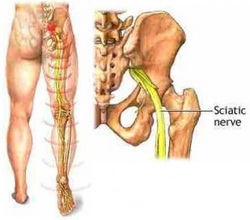
What is Snapping Hip Syndrome? When you walk, get up from a chair or swing your leg around, you may feel or hear a “snapping” sensation in your hip.
What are the causes?
What are the causes?
- Tendon along the thighbone is tight
- Trochanter is out of place
- Stretching
- Reduce activity
- Apply anti-inflammatory mediciation or injection
Osteitis Pubis
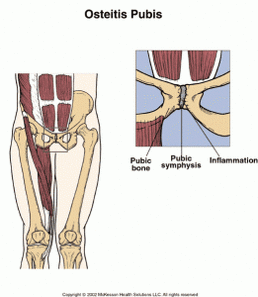
What is Osteitis Pubis ? Osteitis Pubis is a painful overuse condition that affects the pelvis and most commonly occurs during kicking activities, ice skating and dance. Osteitis Pubis affects an area at the front of the pelvis known as the ‘Pubic Symphysis’. The Pubic Symphysis is a cartilaginous (made from fibrocartilage) joint, that is tightly bound by very strong ligaments. This means that only a limited amount of movement is allowed at this joint.
What are the causes?
What are the causes?
- Trauma
- Pelvic operation
- Overuse Injuries